


Mexican Wolf
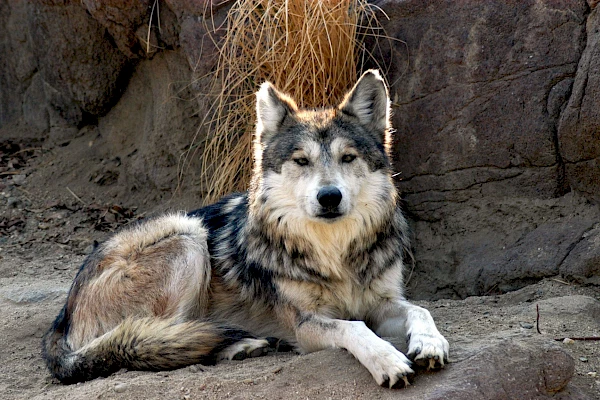
Mexican wolves have a complex social structure and communication system, which includes vocalizations, facial expressions, scent marking and body language.
Their body language is essential in identifying the dominant male. The alpha will stand tall with their tail held high, while other wolves will exhibit a submissive behavior with a lower body and tail.
Through cooperative hunting and precise communication, packs can bring down prey animals usually much larger than themselves by chasing them over long distances and creating confusion.
The Mexican wolf’s major threats are human-caused mortality, loss of gene diversity, and loss of habitat. The Living Desert has played an instrumental role in the comeback of the Mexican wolf for decades.
Desert Bighorn Sheep
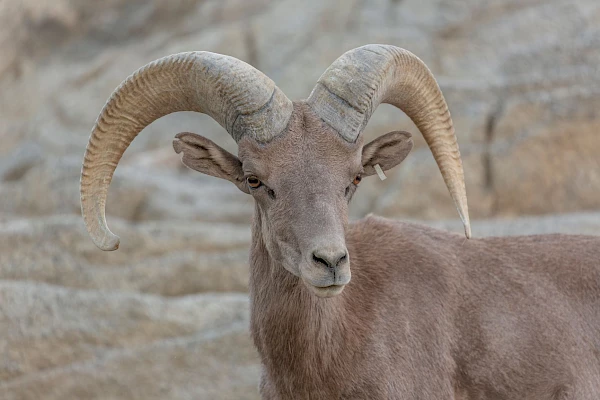
A bighorn sheep’s hooves are strong and split, which provide balance and grip as they forage for water-rich food, evade predators, or battle for dominance.
Males, called rams, have large, curled horns that are made of keratin. Their horns are used in battle with other rams, but also serve as a status symbol within the herd.
Bighorn sheep are threatened by disease, habitat degradation, care collisions, and habitat fragmentation due to urban and commercial development. The Living Desert actively supports the national conservation of this species through the leadership of the Species Survival Plan and local conservation efforts through collaborative efforts with local programs.
Coyote
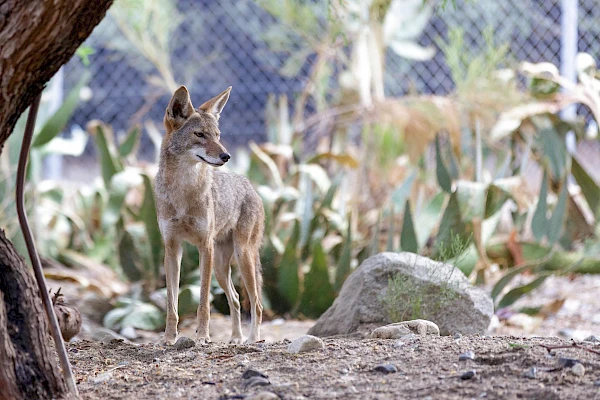
This highly adaptable opportunistic omnivore seems to prefer rodents and jackrabbits, but will eat reptiles, birds, arthropods (scorpions, crickets) and plant material such as juniper seeds, screw beans, fan palm fruit and dates. A crepuscular and nocturnal hunter, they are valuable as rodent control. Their only predator is Man.
Coyotes are dog-like, sandy-colored, with erect ears. They roam extensively throughout their territory, hunting, resting and sleeping wherever they are comfortable, living in a den only when raising pups.
Coyotes usually mate for life and breeding takes place between January and March. The gestation period is 63 days and one litter per year of 1-12 pups (average 4 to 5), is born and raised in a den or rock crevice. Pups are born blind, but furred, will nurse for 5 to7 weeks and begin to leave den at 3 weeks, but it is 6 weeks before they really begin to run with their parents when they all abandon the den. If you see a group of 3-6 coyotes, it is most likely a mated pair and their young of the year, or perhaps a group of litter mates. Coyotes do not have large packs as some wolves do. Their potential lifespan in the wild is about 13 years and in captivity is 15-20 years. They do not make good pets.
Coyotes communicate using scent and body language as well as vocalization.
Chuckwalla
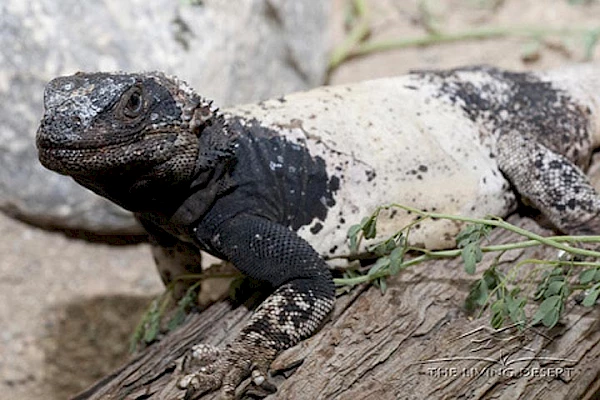
This is a large, stocky, wide-bodied lizard. Males have reddish-pink to orange, yellow or light gray bodies and black heads, shoulders and limbs, while females and the immature have bodies with scattered spots or contrasting bands of light and dark in shades of gray or yellow plus banded tails. Males are generally larger than females, and possess well-developed femoral pores located on the inner sides of their thighs which produce secretions believed to play a role in marking territory.
They are herbivorous, eating buds, flowers, fruit and leaves and obtaining moisture from their food. Their 4-6 month activity period is closely regulated by food availability and they usually retreat into estivation by August and into hibernation during the cooler months.
They are preyed on by golden eagles, hawks, ravens, roadrunners, coyotes, kit foxes, bobcats and snakes. Their tails will detach if grabbed by a predator, allowing them to escape, but they do grow back.
Males defend their territories against other males with head bobbing, pushups and by chasing their rivals away. After courtship displays of head-bobbing, from April to July, mating occurs, and females lay 5-16 eggs, which hatch in late September.
Mountain Lion
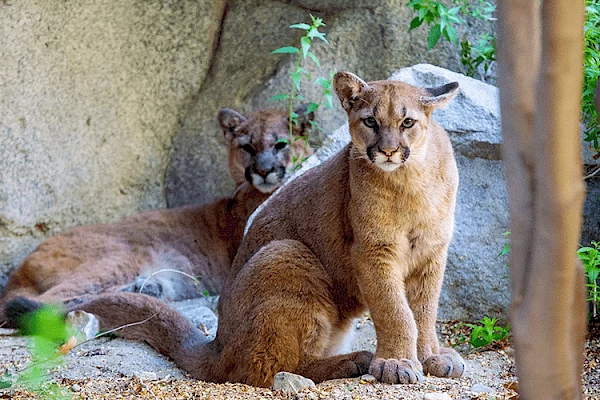
The Mountain Lion is a large, low-slung sandy-colored cat with a small head and a long, heavy rope-like tail. The tail makes up nearly half of the total 6–8-foot length. Males weigh from 100 to 200 pounds; females weigh from 80 to 110 pounds. The tail is long, cylindrical, and about one-third of the animal’s total length. The limbs are short and muscular.
The mountain lion prefers deer, which it captures by stealth, stalking and pouncing upon its prey. A mountain lion must kill to survive, and it is well-equipped to do so. Forward-pointing eyes give it superb binocular vision. A heavily muscled body enables rapid bursts of blinding speed, and huge leaps and razor-sharp claws grip its victim during attack. Powerful jaws with sharp canine teeth bite the neck, severing the spinal cord, and blade-like carnassial teeth slice through hide and flesh. After gorging on its kill, a mountain lion will cover the remains with leaves and debris, returning in a day or two to feed again, then move on and may not kill again for 10 to 14 days. A mountain lion will take elk if they are available, but when large prey is scarce, it will eat anything it can catch: raccoons, porcupines, squirrels, rabbits, foxes and even skunks.
Chacoan Peccary
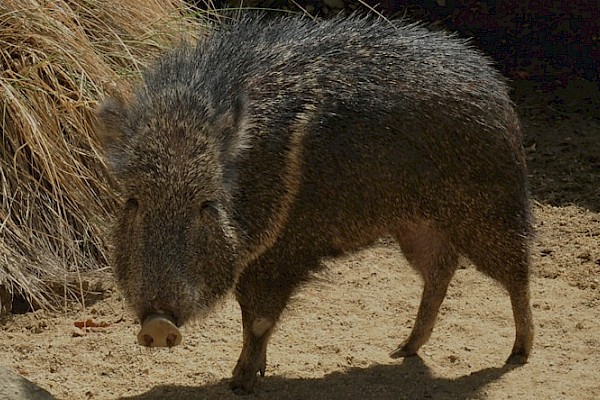
Chacoan peccary is the largest of the peccaries. Males and females look alike. The bristly coat is speckled charcoal or brownish-gray, interspersed with long guard hairs, which may be up to 8-9” long. There is a whitish collar across the shoulders and under the chin, which is thinner and less distinct than that in the Collared peccary. There is a black dorsal stripe, which trails onto the tail. The head is extremely large, and the nose tapers to a snout disc made of cartilage. The long, donkey-like ears are covered with long, pale hair, as are the legs. The legs are relatively long and adapted for running, with dewclaws only on the forelegs.
Chacoan peccary uses its snout to roll cacti on the ground, rubbing the spines off. Its kidneys are specialized to break down acids from the cacti, and its two-chambered stomach is well suited to digest its food. The bristly brownish-gray coat provides excellent camouflage, and peccaries’ tiny feet help them to pick their way through their thorny habitat. Chacoan peccaries also possess a third hind toe, while other peccaries only have two.
North American Porcupine
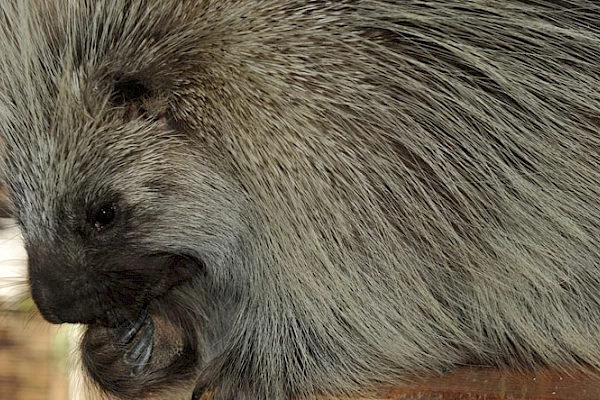
The North American porcupine is the second largest of all rodents in North America. It has a small head, a large, chunky body with a high arching back and short legs. Its head and body are 25” to 40” long, with a long, thick, muscular tail growing as long as 8”. It weighs from 10-40 lbs. Long, yellowish guard hairs cover the front half of its body while up to 30,000 quills are interspersed among the dark, coarse guard hairs of the back and tail. The porcupine’s feet have 4 toes on the forefeet and 5 on the hind feet, all with long, curved claws and small textured knobby pads on the bottom.
Entirely vegetarian, they eat evergreen needles, tree bark, buds, tender twigs, roots, stems, leaves, flowers, berries, nuts, and other vegetation. Porcupines are also known to gnaw on bones and antlers from the ground due to their high mineral content. The two large, front gnawing teeth continue to grow as long as the porcupine lives.
When threatened, the North American porcupine places his snout between his forelegs and spins around presenting its rear to the enemy. If attacked, contrary to popular belief, the porcupine does not throw its quills; instead, it drives its tail against the assailant and dozens of quills detach easily from the skin to remain embedded in the attacker. If hit in the face, a predator such as the wolf, bobcat or mountain lion may die of starvation when they find it impossible to remove the quills and are thus unable to eat.
Bobcat
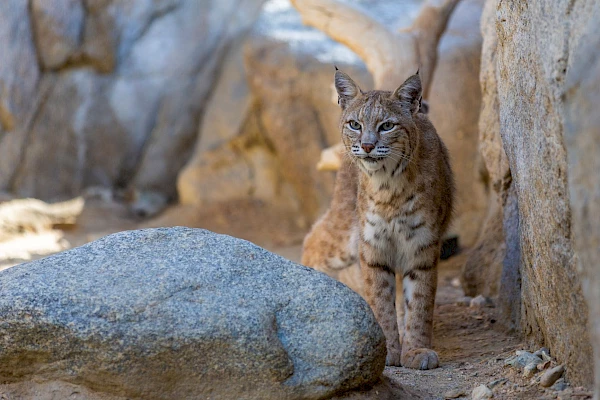
Bobcats are on the alert for prey day or night, which includes rabbits, hares, rodents, quail, reptiles and carrion. Adults are preyed on by mountain lions while coyotes and foxes prey on the young.
Their coats are light brown marked with spots and bars. Their bellies are white with dark markings and their tails are very short and stubby. Males are larger than females. Facial tufts or “sideburns” and ear tufts may aid their keen hearing while black and white ear spots may be used as communication signals.
Males and females come together only for breeding from February to June and, after a gestation period of 60 days, 1-5 kittens are born, which are reared by the mother alone. The kittens leave her at 9-10 months to establish their own territories. Their potential lifespan is 12-14 years in the wild and up to 25 years in captivity.
Bobcat populations vary in size, color, prey type, and home-range size depending on habitat type. They are solitary and, throughout their home ranges, they mark their territories with urine, anal gland secretions, feces or piles of duff or dirt called “scrapes” to warn off other bobcats.
Peninsular Pronghorn
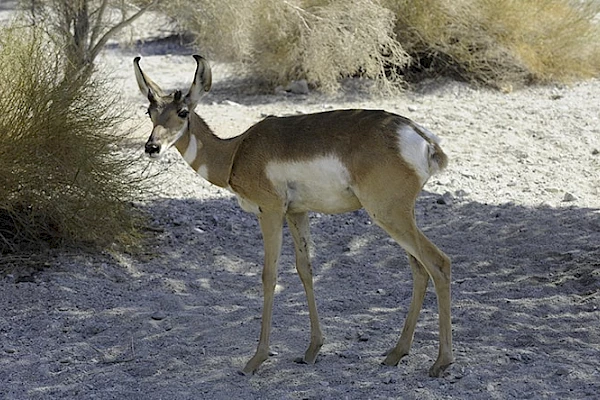
Endemic to North America the pronghorn has a deer-like body, weighs between 90 and 125 pounds, and stands about 3½ feet at the shoulder. It has large, protruding eyes and a white or buff 4-inch tail. The upper body and outside of the legs are tan to brown. The cheeks, lower jaw, chest, belly, inner legs and rump are usually white. The male has a broad, black band down the snout to a black nose and black neck patch, together with black horns.
The eyes of pronghorn are exceptional. They can pick up movement from as far as three miles away. The eyes are located far back on the head so they can keep watch even while the head is down during feeding. They can run at 40 to 60 mph for one hour or more. (Cheetahs run up to 70 mph, but only for about 300 yards.)
Pronghorns’ cloven hooves are padded to absorb shock from strides of over twenty feet at top speed. Their oxygen consumption is three times greater than that of other similar sized animals; the windpipe measures up to two inches in diameter. By comparison, a human’s is three-quarters of an inch. Pronghorn also have an enlarged heart and lungs to aid oxygen consumption, and run with mouth open and tongue hanging out to take in more air.
* Note: This information applies only to this subspecies not the entire species population.