Today’s Hours: 8:00am – 5:00pm


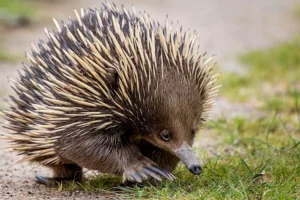
Species Name:Tachyglossus aculeatus
During the mating season, one to ten males form a line and follow a receptive female, sometimes for weeks. The female chooses the most persistent male that walks behind her for…
Read MoreLeast Concern.
This species is widely distributed in mainland Australia, Tasmania, Indonesia, and southern New Guinea.
This echidna is very adaptable and can be found in multiple habitats like grasslands, savannas, deserts, shrublands, and forests.
During the mating season, one to ten males form a line and follow a receptive female, sometimes for weeks. The female chooses the most persistent male that walks behind her
for the longest time. To deter predators, they curl into a ball or dig a shallow hole into the ground, and expose their sharp spines.
The short-beaked echidna is one of the five living species of egg-laying mammals. It has a compact body covered with sharp spines on the back and sides, short legs and tail, and a long, tubular snout. It lacks teeth but has a long, sticky tongue to catch its prey. Its very strong claws are used for digging and foraging for insects. Females have pouches on their undersides and males have small spurs on the hind legs.
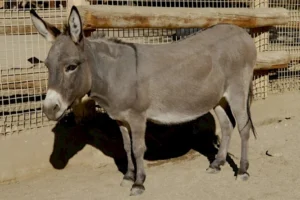
Species Name:Equus asinus asinus
This is a miniature breed of donkey, whose coat comes in various colors (black, brown, white or spotted), but is most commonly gray. They are only 28 to 38 inches tall…
Read MoreEquidae, the horse family.
Domesticated breed of donkey.
Africa, the Middle East, Asia, Australia, England and also parts of North America.
Warm, dry areas and deserts.
If a group of donkeys is attacked, they will form a circle and fight the predator with their hooves.
This is a miniature breed of donkey, whose coat comes in various colors (black, brown, white or spotted), but is most commonly gray. They are only 28 to 38 inches tall at the withers (shoulder) and weigh between 250 to 450 pounds. They eat hay, grass, oats and grain and graze from dawn until late morning and then again in late afternoon. In open range, they may be susceptible to large carnivores.
Donkeys are widely distributed and can be found almost everywhere in the world. However, true wild asses originated in the undulating deserts of northern Africa and the Arabian Peninsula and are well-adapted for life in the desert. Domestic donkeys prefer warm, dry climates, and if left to become feral, they will return to such a habitat if possible, for instance, the wild population in Death Valley.
Breeding occurs primarily during late spring to early fall and after a gestation of about 11 months, one foal is born. They usually reach maturity at around the age of 1 or 2. They are highly resistant to diseases, and remain healthy into old age, which can be over forty years.
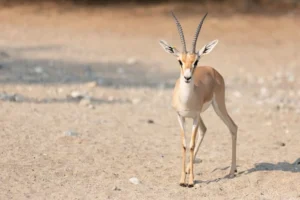
Species Name:Gazella leptoceros
This gazelle is a true desert animal, always on the move with a small herd, preyed on in the wild by lions and jackals. It displays the nervous vigilance typical of…
Read MoreBovidae, The cow and goat family.
Endangered, IUCN.
Africa, The Sahara Desert west of the Nile River.
Sandy lowlands and dunes.
In Arabic, “ghazal” means “bright-eyed.”
This gazelle is a true desert animal, always on the move with a small herd, preyed on in the wild by lions and jackals. It displays the nervous vigilance typical of a prey animal, signaling alarm with a snort or flick of the tail, warning the herd to flee.
It is small, measuring 28″ at the shoulder, and is a pale sandy color above with white below to blend with the sands, a very faint flank stripe and splayed hooves which increase foot surface for walking through deep and extensive stretches of sand. The 15″ long horns are ringed and only slightly curved. It has large, dark eyes and long ears. Its diet consists of leaves, grass and any other vegetation available.
Mating occurs in fall and young, often twins are born after a 5-month gestation and can walk within minutes. Mother hides them in the shrubbery, snorting at them when she is ready to nurse.
As a ruminant, a gazelle swallows its food unchewed, which allows it to consume large quantities of hard-to-digest plant material at one feeding, then to rest in a safe place to chew its cud. It can go long periods without water, getting most of its water from the vegetation consumed.
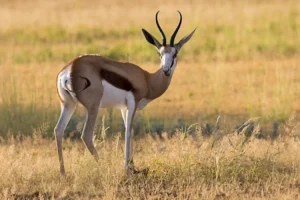
Species Name:Antidorcas marsupialis
Springbok are known for their pronking ability, in which they spring into the air lifting all four feet at the same time. Although closely related to gazelle, springbok have a unique…
Read MoreBovidae
Least Concern
Southwest Africa
Dry grassland
Springbok are known for their pronking ability, in which they spring into the air lifting all four feet at the same time.
Springbok are known for their pronking ability, in which they spring into the air lifting all four feet at the same time. Although closely related to gazelle, springbok have a unique structure and white patch of hair on its back that is displayed when excited or pronking. Springbok are the most abundant plains antelope, and have been documented to run at speeds of 55mph. Threats: Predators include cheetah and wild dogs.
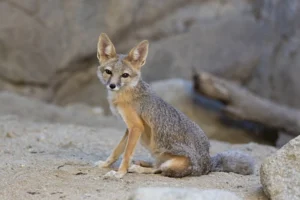
Species Name:Vulpes velox
The Swift fox is strictly a prairie species, but shares many characteristics with its desert cousin, the Kit fox, Vulpes macrotis. Unlike other North American foxes, both species use burrows year…
Read MoreCanidae, the dog family.
Least Concern, IUCN.
Western North America
Short grass and mixed grass prairie
Dens can get very complex with up to 24 “entrances”, although most have only two to seven.
The Swift fox is strictly a prairie species, but shares many characteristics with its desert cousin, the Kit fox, Vulpes macrotis. Unlike other North American foxes, both species use burrows year round, not just for raising young. This behavior is an adaptation for conserving water in the arid environment of deserts and prairies. Both species spend the entire day inside the burrow when the above ground temperatures are at their highest and the air the driest. The burrow environment is many degrees cooler and much more humid then the above ground during the day. A hot fox would need to pant to keep cool, thus using valuable water just to keep cool. At night both species are active pursuing their preferred prey of rodents and rabbits when the external temperatures are lower, the humidity is higher, and their prey most active. Both the Swift fox and the Kit fox can live in environments where there is no free water getting all of their water needs from the bodies of their prey. A ground squirrel’s body is 70% water.
Some populations are rare or extirpated due to habitat loss, and predator and rodent control programs.
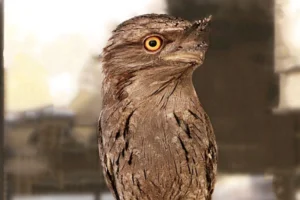
Species Name:Podargus strigoides
Masters of camouflage, tawny frogmouths sleep on low tree branches during the day. When disturbed, they stiffen their body and stretch their neck, simulating a broken tree branch – a behavior…
Read MorePodargidae
Least Concern
Australia and Tasmania
Forests, scrublands, woodlands, grasslands
The tawny frogmouth is named for its wide, frog-like beak. This nocturnal and carnivorous bird is often mistaken for an owl.
Masters of camouflage, tawny frogmouths sleep on low tree branches during the day. When disturbed, they stiffen their body and stretch their neck, simulating a broken tree branch – a behavior called “stumping.”
If provoked, they react with a hissing noise, a startling snap of their yellow-lined beak, and a defensive pose that makes them appear larger.
Tawny frogmouths are threatened by vehicle collisions, habitat loss and degradation, agricultural toxins, and predation by feral cats, dogs, and foxes.
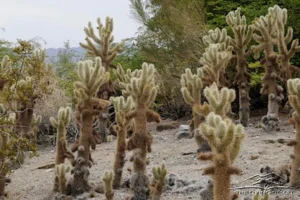
Species Name:Cylindropuntia bigelovii
Read MoreCactaceae, Cactus Family
Sonoran Desert and warmer regions of Mohave Desert in southeastern California, southwestern Arizona, western Sonora and Baja California
Sandy flats, gravelly to rocky washes, bajadas and hillsides below 3,000 feet elevation
Stem succulent to 3 to 5 feet tall
Ethnobotanic Garden, Upper Colorado Garden, Yuman Garden
Since this species usually makes no viable seed, it relies on detached segments to form new plants by rooting and growing.

Species Name:Acacia tortilis
Read MoreFabaceae, Pea Family
Widespread throughout Africa and into the Middle East
Semi-arid savannahs in sandy, rocky and alluvial soils
Tree, shrub; from 6 feet by 6 feet to 50 feet high by 100 feet wide
East African Garden, Village Watutu
Balls of fragrant, creamy-white flowers occur in late spring to summer and are favored by monkeys and baboons.