Today’s Hours: 8:00am – 5:00pm


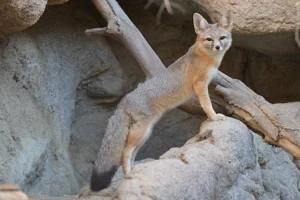
Species Name:Vulpes macrotis
A very small, pale, yellowish colored fox with big ears, pointed nose and long bushy black-tipped tail. Being so small (3-4 lbs.), it is often confused with a coyote pup. Kit…
Read MoreCanidae, dog and coyote family
Least Concern, IUCN
Southwestern United States and northern and central Mexico
Desert scrub, chaparral, and grasslands
Kit foxes are the smallest member of the family Canidae in North America
A very small, pale, yellowish colored fox with big ears, pointed nose and long bushy black-tipped tail. Being so small (3-4 lbs.), it is often confused with a coyote pup. Kit fox is about 15-20 inches long, gray fox 20-30 inches. Light sandy color (camouflage), heavily furred feet (for getting about on loose sand), great speed for short distances, agility of a cat combined with keen senses of hearing and smell, all add up to making the kit fox a most capable nocturnal predator on desert dunes. Big ears help to dissipate heat in desert environment.
They like to rework a kangaroo rat burrow or dig its own in the sand, among the roots of a creosote bush or other plants for support. Burrow serves as protection from daytime desert heat and aridity, wind and sandstorms. Burrow provides safety for young. Nocturnal. Active all year, does not hibernate.
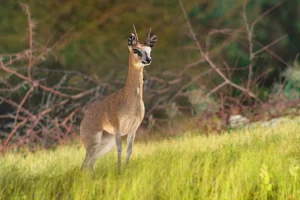
Species Name:Oreotragus oreotragus
Gracefully and quickly, they spring between rocks to search for food or evade predators. Primarily active in the morning or late afternoon hours, klipspringers react immediately to the sight of predators…
Read MoreBovidae
Least Concern
Eastern and Southern Africa
Grasslands
Klipspringers are rock-climbing masters. With special hooves, that make it appear they’re on tip-toe, these antelope are nimble make their homes in the rocky outcroppings, called kopjes.
Gracefully and quickly, they spring between rocks to search for food or evade predators. Primarily active in the morning or late afternoon hours, klipspringers react immediately to the sight of predators and the alarm call of other animals. Adults form monogamous pairs and use vocalizations to communicate. Threats: Predator.
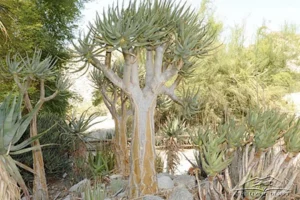
Species Name:Aloidendrion dichotomum
Quiver tree is a distinctive tree aloe with a thick, smooth light-brown colored trunk and blue-green leaves at the tips of its forked branches. Quiver trees live up to 80 years…
Read MoreAsphodelaceae, Aloe Family
Southwestern Africa
Arid, rocky areas
Tree, succulent
In habitat the copious nectar of the blossoms draws birds and insects as well as baboons that can strip a tree of its flowers in a short time.
Quiver tree is a distinctive tree aloe with a thick, smooth light-brown colored trunk and blue-green leaves at the tips of its forked branches. Quiver trees live up to 80 years and can reach heights up to 21 feet. Its tubular canary-yellow flowers appear in the winter months and provide food for nectar feeding sugarbirds. Weaverbirds often build nests in the branches of Quiver trees where young are afforded protection from predators. Quiver trees’ natural habitat lies in arid, rocky areas in northwest South Africa and Namibia. The indigenous San people would hollow out the tubular branches to form quivers for their arrows.
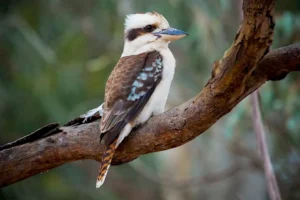
Species Name:Dacelo novaeguineae
The laughing kookaburra is the most prominent member of the kingfisher family and gets its name from its maniacal-sounding call, replicating a variety of chortles, deep laughs, and hoots. Nicknamed the…
Read MoreAlcedinidae
Least Concern
Eastern Australia, Western Australia, Tasmania, New Zealand
Woodlands and forests
The laughing kookaburra is the most prominent member of the kingfisher family and gets its name from its maniacal-sounding call, replicating a variety of chortles, deep laughs, and hoots.
Nicknamed the “bushman’s alarm clock” for its early dawn and dusk cackling, family groups of kookaburras live in the same territory year-round and communicate boundaries to other groups with their distinctive calls.
Laughing kookaburras can alter their loud vocalizations to find others for courtship, raising alarms, showing aggression, and begging for food.
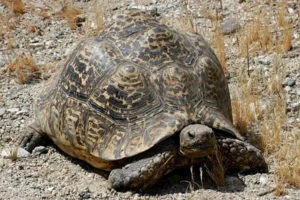
Species Name:Psammobates pardalis
They are large and attractively marked, with high, domed carapaces. Their leathery skin is cream to yellow in color, and their carapaces are marked with black blotches, spots or even dashes…
Read MoreTestudinidae, the tortoise family.
None.
Sub-Saharan Africa.
Sub-Saharan Africa.
Leopard tortoises are the fourth largest species of tortoise after the Sulcata tortoise, the Galapagos tortoise and Seychelles Island tortoise.
They are large and attractively marked, with high, domed carapaces. Their leathery skin is cream to yellow in color, and their carapaces are marked with black blotches, spots or even dashes or stripes, each individual’s markings being unique.
They are herbivorous and graze extensively upon mixed grasses. They also eat succulents and thistles. Both eggs and young are easy prey for monitor lizards, storks, crows and small mammals.
They are very long-lived animals with life spans up to 100 years, and they seldom mature until between the ages of 12 and 15 years. “Courting” consists of males ramming females. After mating, females dig a hole and lay between five and 18 eggs which take from 120 to 150 days to hatch.
Like most tortoises, they can retract their head and feet into their shell in defense when threatened. Also, like all tortoises and turtles, their mouth is a “beak”. Their hind legs are very like an elephant’s legs and their front legs are almost paddle-shaped with “pigeon-toes” and a row of small “nails”. They can move very fast on these legs and maneuver easily over rocky terrain. Young tortoises have even been observed climbing.
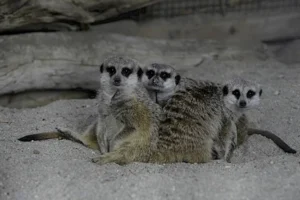
Species Name:Suricata suricatta
Meerkats have small slender bodies, tan or gray with dark bands across the back and sides, a pointed nose, big dark eyes, small round black ears – which they can close…
Read MoreViverridae; the mongoose family
Least concern, IUCN; not threatened.
Southwestern Africa
Inhabit burrows on desert and savanna flats
Whether out foraging or just playing near their burrows, there is always a “watch meerkat” posted to warn the group of approaching danger.
Meerkats have small slender bodies, tan or gray with dark bands across the back and sides, a pointed nose, big dark eyes, small round black ears – which they can close to keep sand out – and a smooth slender tail with a black tip. Their claws are non-retractable and stout for digging. Meerkats are mostly insectivorous, but will also eat small mammals, birds, reptiles, bird and reptile eggs and sometimes tubers and fruits. Their predators include eagles, hawks, jackals and large snakes.
Meerkat packs can consist of up to 50 members. The alpha pair reserves the right to mate and will normally kill young that are not its own and even evict mothers of such offspring which may then form a group of their own. Two to four young are born, sparsely furred and blind. Group behavior is important during the breeding season for babysitting. One or more adults remain in the burrow to baby-sit while others go out to forage and feed. Thus, the young are cared for by their fathers, uncles, aunts and cousins as well as their mothers.
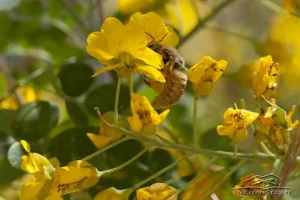
Species Name:Caesalpinia mexicana
Read MoreFabaceae, Pea Family
Lower Rio Grande Valley of Texas, central and northern Mexico
Bushy thickets
Shrub or multi-stemmed tree
Demonstration Garden, Chase Administration (Lurie Patio)
This shrub-like tree has landscape value as a small patio tree or background shrub, and is attractive to hummingbirds.