Today’s Hours: 8:00am – 5:00pm


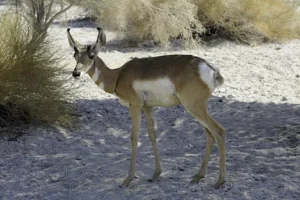
Species Name:Antilocapra americana peninsularis
Endemic to North America the pronghorn has a deer-like body, weighs between 90 and 125 pounds, and stands about 3½ feet at the shoulder. It has large, protruding eyes and a…
Read MoreAntilocapridae, Pronghorn antelope family
Endangered
Baja California.
Peninsular pronghorn – deserts and semi-deserts
They are the world’s fastest living hoofed mammals and the second-fastest land mammals.
Endemic to North America the pronghorn has a deer-like body, weighs between 90 and 125 pounds, and stands about 3½ feet at the shoulder. It has large, protruding eyes and a white or buff 4-inch tail. The upper body and outside of the legs are tan to brown. The cheeks, lower jaw, chest, belly, inner legs and rump are usually white. The male has a broad, black band down the snout to a black nose and black neck patch, together with black horns.
The eyes of pronghorn are exceptional. They can pick up movement from as far as three miles away. The eyes are located far back on the head so they can keep watch even while the head is down during feeding. They can run at 40 to 60 mph for one hour or more. (Cheetahs run up to 70 mph, but only for about 300 yards.)
Pronghorns’ cloven hooves are padded to absorb shock from strides of over twenty feet at top speed. Their oxygen consumption is three times greater than that of other similar sized animals; the windpipe measures up to two inches in diameter. By comparison, a human’s is three-quarters of an inch. Pronghorn also have an enlarged heart and lungs to aid oxygen consumption, and run with mouth open and tongue hanging out to take in more air.
* Note: This information applies only to this subspecies not the entire species population.
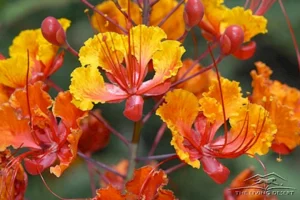
Species Name:Caesalpinia pulcherrima
Read MoreFabaceae, Pea Family
Northern Mexico to Central America, Caribbean
Slopes, washes, and roadsides
Shrub or Small Tree
Palm Garden
Some like it hot!!! Glorious flowers in the heat of summer.
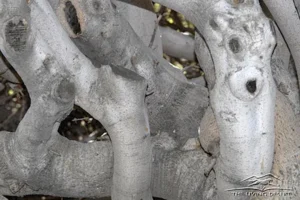
Species Name:Bursera hindsiana
Read MoreBurseraceae, Torchwood Family
Baja California and coastal Sonora, Mexico
Rocky hillsides, slopes, and washes
Shrub, small tree; sarcocaulescent
Vizcaino Garden, Foothills of Sonora, Eagle Canyon
It’s wood, used by Seri Indians, is hard and does not crack as it dries, making it easy to carve.
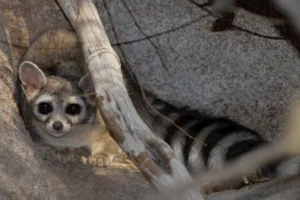
Species Name:Bassariscus astutus
Small, cat-like animal with a long fluffy, black and white ringed tail. Body color is grayish brown. Delicate pointed face and dark, round eyes. Total length is 25-30 in. (half of…
Read MoreProcyonidae, coati and raccoon family
Least concern, IUCN
Southwestern North America from Oregon south to Central Mexico
Various – including semi-arid oak forest, pinyon pine or juniper forest, chaparral, desert, rocky areas and canyons.
Modern ringtails so closely resemble their upper tertiary (2 mil.+ years) ancestors that they are like living fossils.
Small, cat-like animal with a long fluffy, black and white ringed tail. Body color is grayish brown. Delicate pointed face and dark, round eyes. Total length is 25-30 in. (half of that is tail), shoulder height is 6 inches, weight about 2 lbs. Nocturnal and omnivorous like the raccoon, consuming a great variety of foods: small rodents, birds, lizards, insects, fruits, acorns, berries and other vegetable matter. These animals prefer animals but will eat plants.
Unlike the raccoon, it may be found long distances from water – lives by familiar desert survival techniques: hides from sun during the day, is active at night when it’s cooler and eats anything edible it can find or catch to provide food and moisture. Very agile, can reverse direction and ascend narrow passages by ricocheting off walls. Their hind feet can rotate 180 degrees. Their claws are semi-retractable, making them excellent climbers. When threatened in the open will arch tail over back to look larger and vocalize with barks, screams and high pitched calls. May emit a few drops of musk scent from anal gland but does not spray like a skunk.
Ringtails were often adopted by miners as mousers thus the nickname “miner’s cat.”
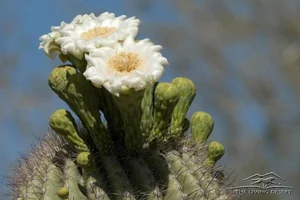
Species Name:Carnegiea gigantea
Read MoreCactaceae, Cactus Family
Sonoran Desert in Arizona, Mexican States of Sonora, Baja California and California
Rocky terrain on desert slopes and flats
Cactus
Yuman Garden, Foothills of Sonora Garden
The Saguaro blossom is the state flower of Arizona and is an important plant for many mammals, birds and insects.
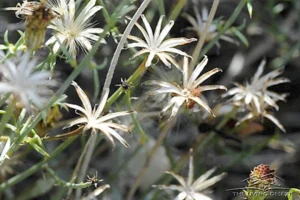
Species Name:Adenophyllum porophylloides
Read MoreAsteraceae, Sunflower Family
Sonoran and southern Mojave Deserts, southeastern California, Arizona, northwestern Mexico
Dry slopes, mesas and washes, Creosote Bush Scrub
Subshrub under 3 feet tall
Upper Colorado Garden
With its addicting scent and beautifully understated flowers, San Felipe dyssodia makes an unusual addition to any butterfly garden.
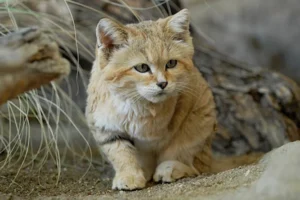
Species Name:Felis margarita harrisoni
Slightly smaller than a domestic cat, it has short legs, a wide head and large tapered ears. Head to tail 32”, 10” tall and weighs 4-5 pounds. Pale sandy with white…
Read MoreFelidae, the cat family
Near Threatened, IUCN
Deserts of N Africa, Arabia and east to Pakistan.
Prefer dunes but will live in rocks.
Sand cats have an exceptionally large middle ear cavity making them extremely sensitive to the small scratching sounds of burrowing rodents as well as large ears that can swivel and funnel sounds to the inner ear.
Slightly smaller than a domestic cat, it has short legs, a wide head and large tapered ears. Head to tail 32”, 10” tall and weighs 4-5 pounds. Pale sandy with white belly, reddish streak from eye across cheek, some dark striping on legs and tail. Tail has a black tip.
Well adapted to desert. Conserves water by spending the heat of the day in a burrow or in the shade. Fur on soles of feet insulate against the burning heat of the ground as well as giving traction on loose sand. Its loud barking call communicates over vast areas of desert (sound does not carry well in dry air). And like many other desert animals, it can live without drinking free water; it gets sufficient moisture from the bodies of its prey.
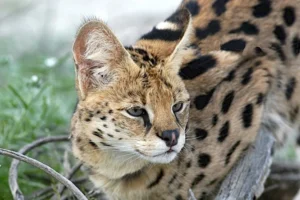
Species Name:Leptailurus serval
The serval is one of seven species of small to medium-sized African cats. It is slender and long-legged with hind legs longer than front legs. Its head is small, with large…
Read MoreFelidae, the cat family.
Least Concern, IUCN, except for endangered isolated North African populations.
Throughout Africa, except for equatorial jungles or the Sahara.
Areas of scrub, tall grass and dry reed beds near streams.
They can jump up to 10 feet to catch birds in flight.
The serval is one of seven species of small to medium-sized African cats. It is slender and long-legged with hind legs longer than front legs. Its head is small, with large rounded ears to help find prey, a long neck and a yellowish tan coat with black markings–different for each serval–to break up its outline, and a light colored underside. Males are slightly larger than females.
Their territories cover up to 5 square miles in areas with good cover for hunting and a water source They eat a wide variety of prey including rodents, small ungulates, birds, lizards, frogs and insects. They require a fresh kill and will eat carrion only under extreme circumstances. Their natural enemies are hyenas, African wild dogs and leopards.
Servals only pair up for mating. A litter of 1-3 kittens is born in a den during the summer months and they are moved frequently to new hiding places. The mother raises her kittens alone and must leave them frequently to hunt. When the kittens are large enough to hunt, males are driven away first, while females stay with their mother until they become sexually mature when they will be driven away to establish their own territories.